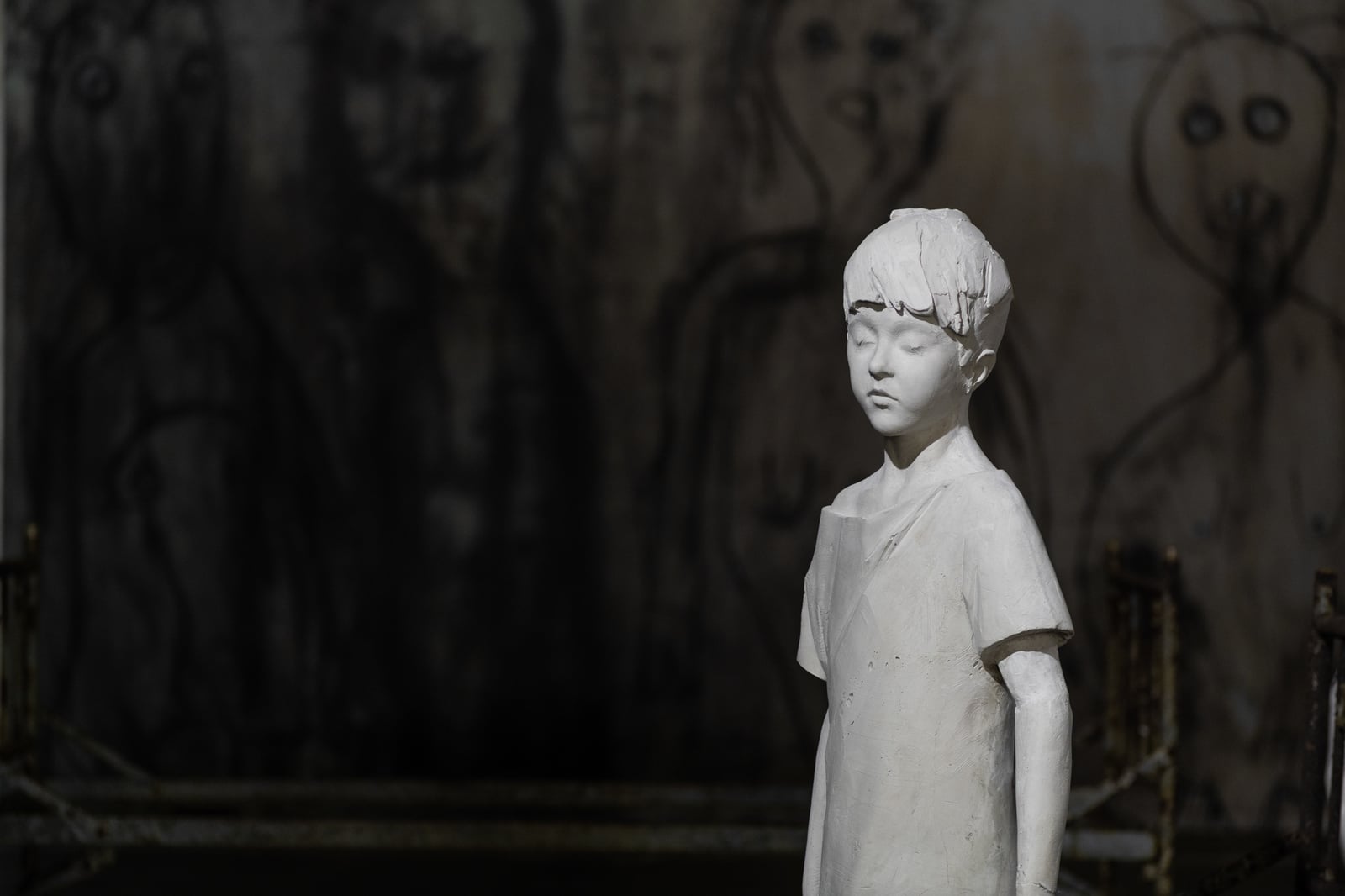
Camp literature and art, as well as post-camp testimonies of former concentration camp prisoners, are a unique example of recording the trauma of enslavement and terror during World War II. They also serve as proof of the importance of art in the search for healing from the effects of an experience encompassing physical and psychological sensations, simultaneously individualized and generational, finding no point of reference, impossible to ultimately define. Examples of the works of former prisoners testify to years of attempts to capture recurring memories in adequate graphic or verbal form. The authors undertook this effort out of a sense of responsibility for preserving the memory of the victims of the Nazi system of exterminating enemies of the Third Reich, passing it on to subsequent generations, but also from the need to find meaning in their own suffering. The leitmotif of the exhibition “The Burden of Salvation” is the literary and artistic record of memories of an experience exceeding the capabilities of the human body. The focus here is on narratives of emotional memory, most strongly ingrained in the body, related to sensory experiences. Following the sensory key for selecting objects are acoustic, olfactory, visual, and tactile tools derived from the themes of the works. The first part of the exhibition is devoted to defining the narrator of the presented works. A unique feature of camp literature is the first-person narrative split into episodes in the singular, with the dominant “I”, and extensive fragments describing the collective hero, “we”. This issue is reflected in the exhibition by a room that smoothly transitions from self-portraits and private correspondence from concentration camps to mass-produced collective portraits and “human anthills”. The theme of identity and lack of intimacy concludes with a space dedicated to the penal isolation of the prisoner and their perception of their own body. Subsequent parts lead through memories of ambient sounds and camp music, kinetic sensations associated with the body’s contact with work tools, everyday objects, camp infrastructure, and the individual experience of hunger, illness, and weather conditions. The central place in the exhibition is occupied by visual stimuli, commonly appearing in descriptions and paintings by former prisoners, landscapes metaphorically linked with captivity and a longing for beauty. Artworks and literary fragments are complemented by historical objects (prisoner’s clothing, a soup bowl, coupons for an extra meal, number patches). The materiality of the concentration camp, evident in the content and structure of the artworks, resonates equally strongly in the phenomenon of Józef Szajna’s narrative recorded on hundreds of disposable napkins presented in the last part of the exhibition. The artist gathered a sum of reflections devoted to the most essential humanitarian values and intimate memories in the form of a work of extremely fragile form, loose structure, and uncountable due to the dispersion of its individual elements. An audio guide leads through successive parts of the exhibition with fragments of memoirs by Wiesław Kielar, Marian Kołodziej, Jerzy Adam Brandhuber, Józef Szajna, Bogdan Kolasiński, Victor Frankl, Maria Zarębińska-Broniewska, Helena Dunicz-Niwińska, and Tadeusz Borowski. The exhibition scenario was inspired by reading unpublished private notes by Józef Szajna, a former prisoner of KL Auschwitz-Birkenau and KL Buchenwald-Schönebeck I. Letters from the camps and notes written in the second half of his life, when juxtaposed with the autobiographical “Bottom” and his artistic output, allowed for a new interpretation of the essence of the materiality of the artist’s painterly and scenographic compositions, the dynamics of the scenes he directed, and the codification and stylistics of his theatrical scripts. The core of the exhibition consists of hitherto unpublished manuscripts and Szajna’s drawings, collages, and scenographic designs corresponding to their content. These works engage in a dialogue with similar voices of many other former prisoners, including Marian Kołodziej, Jerzy Adam Brandhuber, Mieczysław Kościelniak, Krystyna Żywulska, and Franciszek Stryj. The exhibition has a twofold message. In a reality where direct witnesses to many events crucial to our history have passed away, it is difficult for us to identify with film, literary, and museum narratives, just as with textbook knowledge concerning facts from decades ago. The passage of time means that family stories die out, and the custom of passing them on does not continue. For this reason, personal notes and autobiographical works of participants in events deserving of memory gain increasing value for our sense of identity. We hope that closer contact with the experiences of direct witnesses to traumatic events will also raise viewers' awareness of the consequences of long-term stress and suggest ways out. The sensory nature of the exhibition is intended equally to facilitate understanding of both these issues.

The Burden of Salvation. Artists after Auschwitz
By Magdalena Kędzierska
Jan 30 – Jun 28, 2026